The Four Layers of AI Maturity
Every person and every team using AI sits on one of four rungs. Obvious, Creative, High Stakes, Profound. Most are stuck on the first one and do not know it. Here is the ladder, and how to climb it.
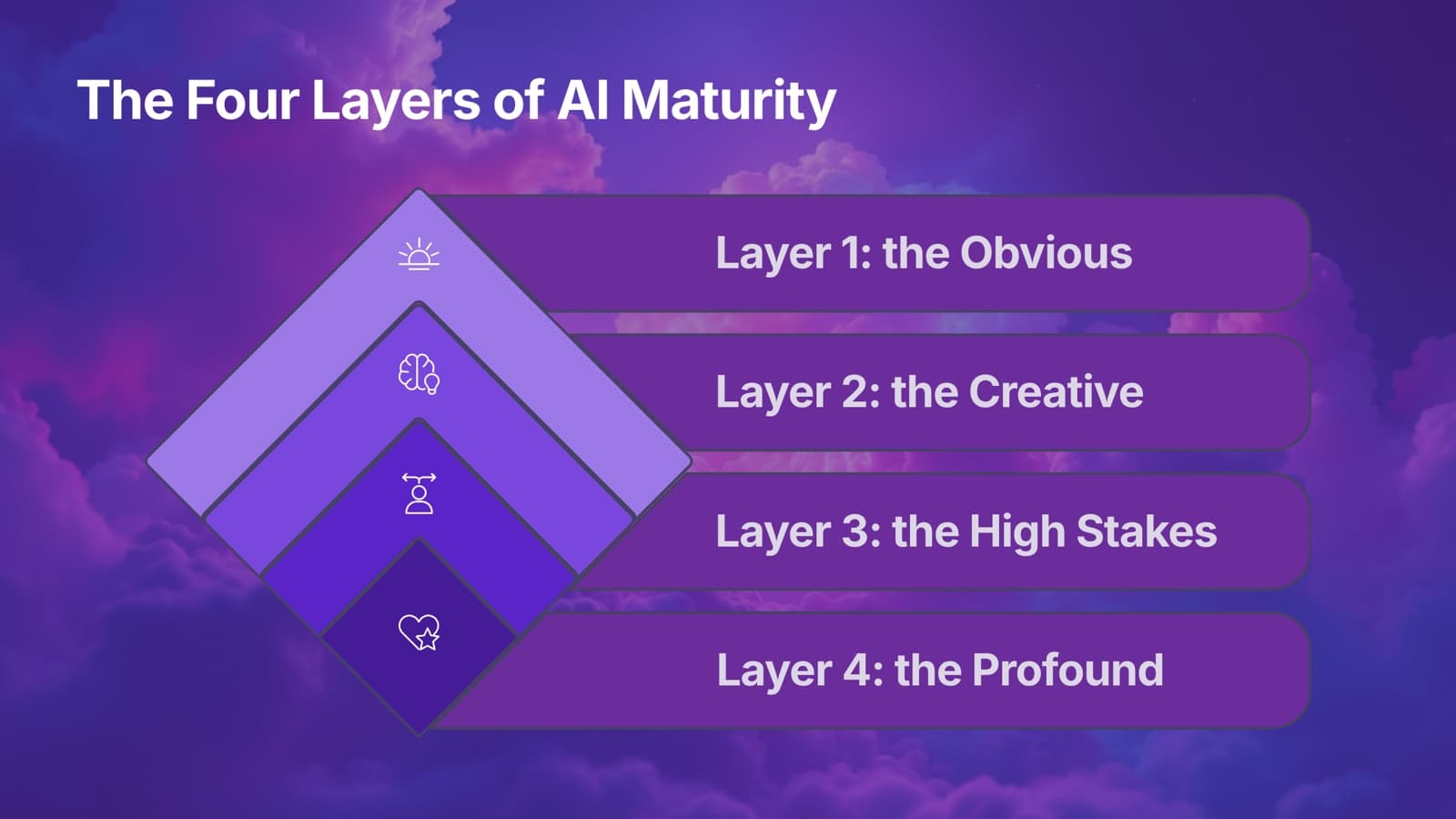
Almost everyone I meet is using AI. Far fewer are climbing with it.
There is a ladder hiding inside how people use these tools, and once you can see it, you cannot unsee it. Four rungs. I call them the Obvious, the Creative, the High Stakes, and the Profound. Most people, and most teams, are standing on the first rung, doing the things you would expect, and quietly assuming that is what AI is for.
It is not. The value compounds as you climb. Here is the whole ladder.
Layer one: the Obvious
This is the stuff you would expect. The work AI was obviously going to touch.
Your inbox does not manage itself. So you point AI at it. "Review my inbox since Tuesday, give me the headlines, a table of what needs my response, who it is from, what it is about, the action, when it is due, and a suggested reply based on how I have answered similar emails before." You run it every Friday at 2pm and you sleep better on a Friday night.
The same layer covers your LinkedIn post after a good conference, the tactical brief before a meeting with a client you have not seen in six months, the decision log pulled from two years of email with a supplier. Useful. Real. A genuine time saver.
But here is the trap. Most people arrive on the Obvious layer, feel the relief of a tidier inbox, and stop. They conclude that AI is a faster way to do the admin they already did. That is the default ceiling, and the overwhelming majority of professionals are sitting under it right now, convinced they have understood the technology.
They have understood one rung of four.
Layer two: the Creative
This is the layer you reach at home, and it is the most undervalued business habit of the year.
Playing with this stuff in private is not a waste of time. It is the on-ramp. The people getting outsized value from AI at work are almost always the ones treating it like a toy on the weekend.
A handwritten McDonald's order, photographed and dropped into AI with one instruction: read this, find the cheapest combination of meals, show me product versus meal pricing. Nearly 20 percent saved, and a small lesson learned about feeding images in and structuring a prompt. A children's storybook generated for a seven-year-old. Six frequent-flyer tickets found by an agent browsing an airline site on your behalf.
None of this is work. That is exactly why it matters. When you play, you build pattern recognition with no stakes attached. Then it transfers. The CFO who watched that storybook demo went back to his office, ran his board report through the same tool with a "make a storybook out of this" prompt, and used the result to find a sharper narrative arc through his numbers. He did not present the storybook. The play changed how he told the real story.
People who only ever touch AI at work stay shallow. People who muck around at home develop the chops they bring back to the office. The Creative layer is the bridge, and most teams skip it because it does not look like work.
Layer three: the High Stakes
This is where the return on investment shows up.
Record every meeting. I cannot impress this on you strongly enough. The transcript is the asset and the agent is the lever. Once you have the recording, you stop taking notes by hand and start asking: what was the purpose, who was there, what was decided and why, what are the action items, how is my relationship with this client tracking based on the language patterns. A hundred meetings recorded and queryable beats a year of memory.
Rehearse before it counts. You would never pitch for the first time in front of a client. So do not. Brief an AI to play the buyer, the board member, the difficult stakeholder, and run the conversation in voice mode before you walk in. You have an unlimited rehearsal partner now. The only question is whether you set the brief.
Run the audit you have been avoiding. I loaded 15 months of credit card data into AI, told it to act as an elite financial analyst, and asked for waste detection. Twenty minutes later I had clawed back 6,000 dollars in subscriptions I was not using, with the overlaps colour-coded and the keep-or-cut calls already made. Run that same workflow at the org level against the general ledger and it is a procurement review that used to be a six-figure external project.
This is the layer where AI stops being a convenience and starts being a line on the P&L. Most organisations never reach it, because they never left layer one.
Layer four: the Profound
This is the rung nobody puts on a roadmap, and it is where the real shift happens.
When AI is your daily default, it stops being a tool for tasks and becomes a thinking partner for the things that matter most. The decision you have been circling for a month. The difficult conversation you need to rehearse before you have it for real. The setback you are trying to make sense of. The plan for a milestone that matters. Work that never shows up on a task list, but shapes everything that does.
People reach this layer not by planning to, but because AI has become part of how they think, not just part of how they work. The question changes. You stop asking "can it do this task" and start asking "how do I want to think about this".
A boundary matters here. AI is not a substitute for professional advice, or for a doctor, a therapist, a lawyer, or a trusted human. But as a partner for reflection, in the moments you might otherwise sit with alone, it can help you think more clearly and move with more confidence.
This is the layer that separates people who use AI from people who have been changed by it.
Where are you, and where is your team?
Here is the self-assessment. Be honest.
Obvious only. You use AI for email, drafts, and summaries. It saves you time. You have concluded that is what it is for. Most people live here.
Creative. You play with it at home. You experiment without a goal. You have noticed those experiments quietly making you better at work.
High Stakes. You record and interrogate your meetings. You rehearse before the conversations that count. You have run an audit or built an agent that produced a number a CFO would care about.
Profound. AI is a thinking partner for decisions and moments that are not on any task list. It has changed not just what you do, but how you think.
Now run the same assessment on your leadership team. The honest answer in most organisations is that the senior people are stuck on Obvious, the few high performers have found their way to High Stakes through private Creative play, and almost nobody has been given permission to explore the Profound.
That gap between layers is the real maturity gap. Not which platform you bought. Which rung your people are standing on.
The climb
The businesses pulling ahead are not the ones with the best AI tools. They are the ones whose people have climbed the ladder. The platform you use barely matters. The rung you are on is everything.
So the question is not whether you use AI. Almost everyone does. The question is how high you are willing to climb, and whether you will give your team permission to climb with you.
What could you do tonight that felt impossible 30 minutes ago?
Justin Kabbani
AI Keynote Speaker, Strategist & Trainer
Help your team climb the ladder
Justin's workshops and training take teams from the Obvious layer to the High Stakes layer, where the return on AI actually shows up. Built around your platform and your people.
Explore AI Strategy & Training